


Savdie / Soutine
September 10 - October 24, 2026
Gallery Exhibition at 48 Walker Street
At the press opening for SAVDIE/SOUTINE which was held Thursday evening, September 10th, Ilana Savdie said many intelligent things, one of which was that, while creating a painting she “doesn’t have to adhere to anything other than [her] own logic but it has to have a logic.” This is true of every successful painting – indeed every successful work of any kind of art. A work has to operate within a consistent set of laws that the artist sets for it.
Soutine’s logic always makes immediate sense to me – from the time I first encountered his works as a child. Not all Soutine paintings rise to the rules that he sets for them. He has weak canvases. His weak canvases can be edifying because they give a viewer room to understand Soutine in a different way – you learn things about a person by watching him fail, and this is especially true of geniuses who set punishingly difficult standards for themselves, standards which they sometimes fail to meet. But great Soutine canvases are wholly engrossing to me, and part of the reason that I find them so captivating is that their logic is complicated, soulful, and, to me, infinitely fascinating.
“Why did you choose to write a book about Soutine?” is a question I was often asked while and just after working on the artist’s biography. The honest answer is that Soutine works on me in a way that no other painter does. With other painters, even painters who have occasioned essential developments in my understanding of art and of the world, it takes me a little while to acclimate to their world and to learn how to see the way their paintings are asking me to see. While standing in front of most paintings I need to give myself the time to move away from my own logic and into theirs. Not so with him.
The Soutine paintings at SAVDIE/SOUTINE offer the strongest experience of Soutine’s paintings I have ever had in one place. There is not a single weak canvas in the bunch, and every one of them offers a different version of Soutine operating at the highest level of many of his early iterations. Soutine moved through many phases. His paintings from different periods and of different subjects are in certain ways essentially different from one another. The ones that are on display at Norr Cohan are all from between 1919 and 1926 – he developed a great deal in just those seven years and many of his deepest interests from that period are given air and space in the gallery.
Because I have such an intense relationship with Soutine it is not possible for me to give Ilana Savdie the attention or understanding that I can give Soutine. Other attendees will be able to visit this exhibition and experience Savdie’s work on its own terms, as paintings in their own right and not as foils to Soutine’s paintings. But it is not possible for me to do that and it would be unfair to try since I know far more about his works and about him than I do about her.
That said, pairing the two painters together was a kindness to Soutine because it will give viewers who are either new to his work or who do not know how to look at him a sort of guide. Savdie’s canvases translate Soutine, they give people who would find his logic and his presentation confusing a way into the work.
One of the challenges Soutine poses for his viewer is the task of identifying and distinguishing between different directions of energy within a single painting that work both against and in rhythm with one another. Paysage du Midi below is a landscape painted in 1919 in the south of France. It is from the very beginning of Soutine’s first important artistic period, commonly called “the Céret period” because he spent most of it in Céret, a small town on the border with Spain in the foothills of the Pyrenees.
The Céret paintings are Soutine’s most tightly painted. They are both claustrophobic and pulsing with pent up energy. They feel airless – even the sky in the paintings withholds the relief of open space. Because so many different kinds of energy are bound up in one another in Soutine landscapes, and in the Céret landscapes in particular, it can be difficult to discern between them, and difficult to come to understand that what you are looking at is a landscape with foregrounds, middleground, and background.
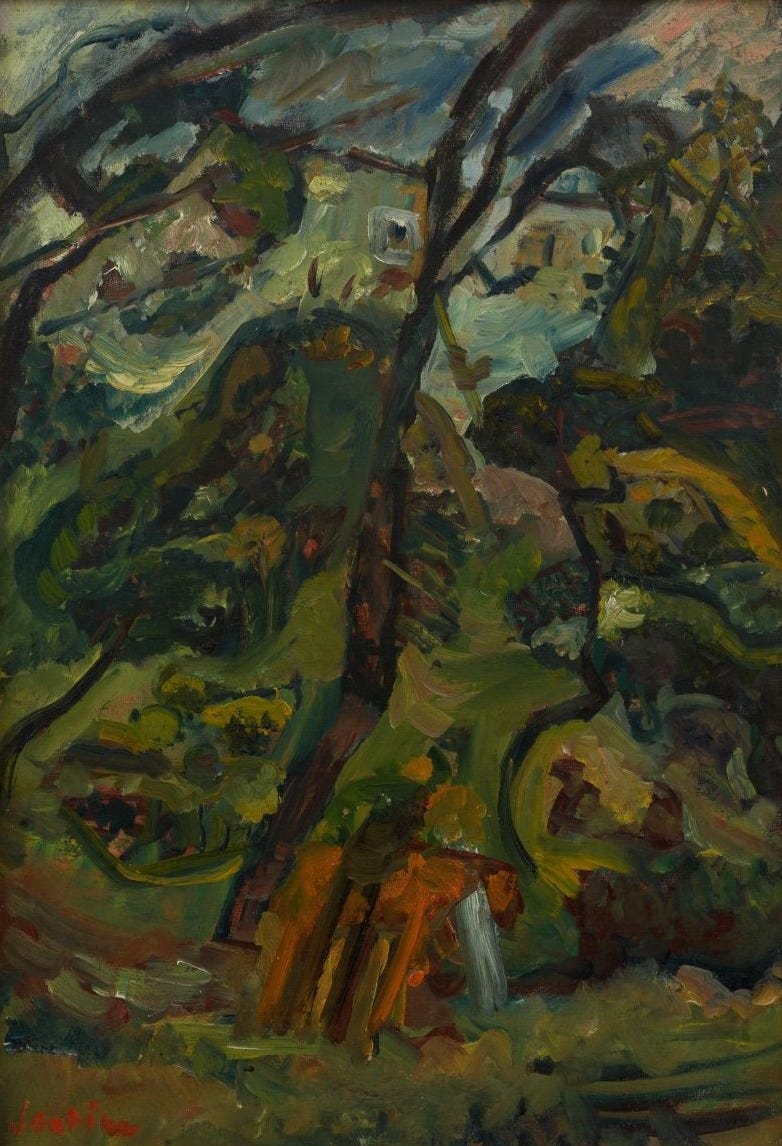
But with a Savdie painting hanging beside it, a viewer is reminded that a single painting can be composed of different planes of motion. Ilana Savdie shows viewers that the whipped-ness in her paintings is related to the motion in a Soutine. Her clear, decisive, vaunting choices rhyme pleasingly with his tight, claustrophobic ones. It is like watching two dancers with very different charismas make complementary motions with their bodies side by side.
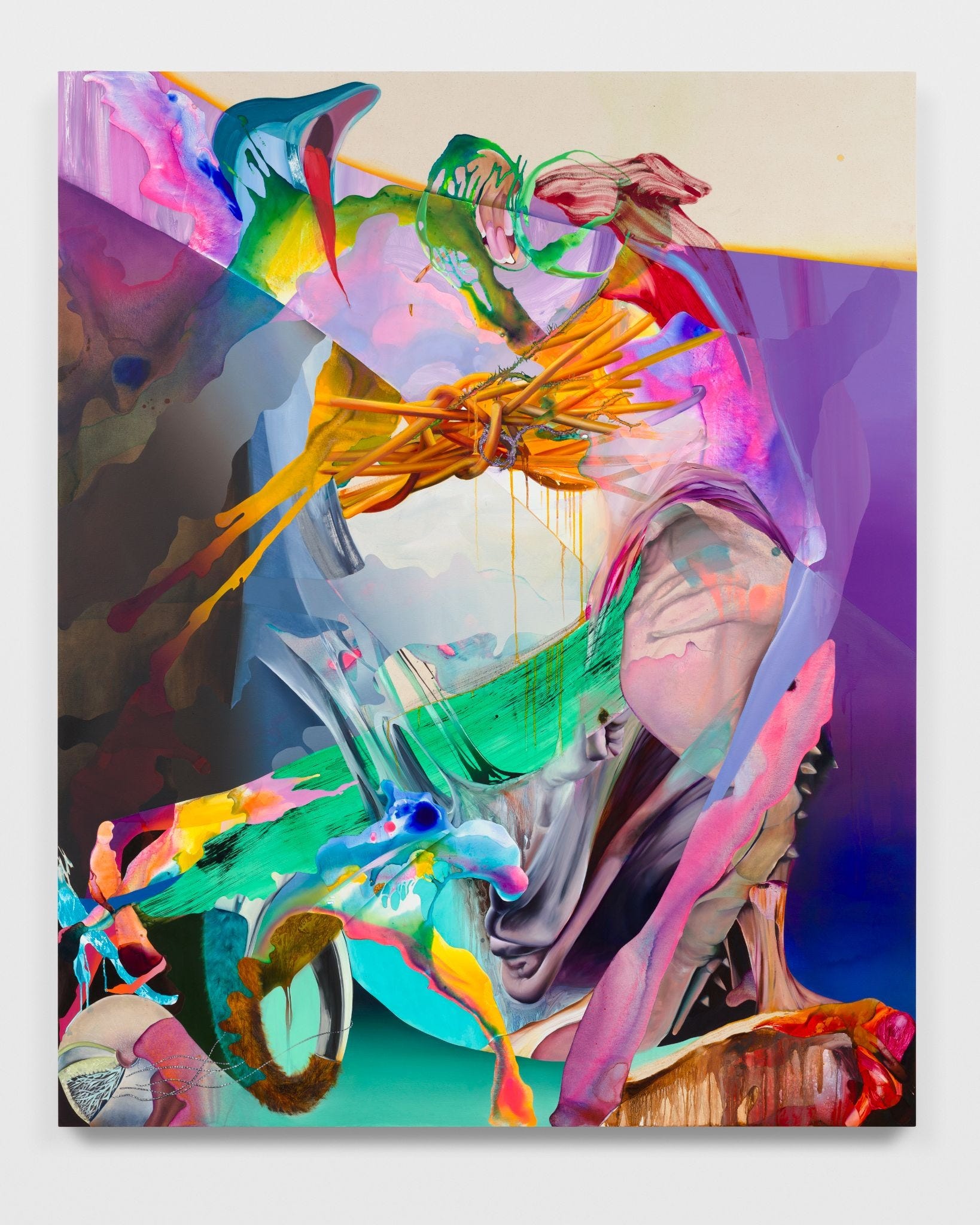
Soutine’s motions are never the same. All of his canvases vibrate, and all with a unique vibration. His early landscapes especially distribute the energy of his work equally across the surface of the painting. But as he got older he enjoyed concentrating the energy in a particular place and allowing the background of the canvas to hum at a lower register. One of the finest examples of this development is his fowl series of hanging birds. This one:
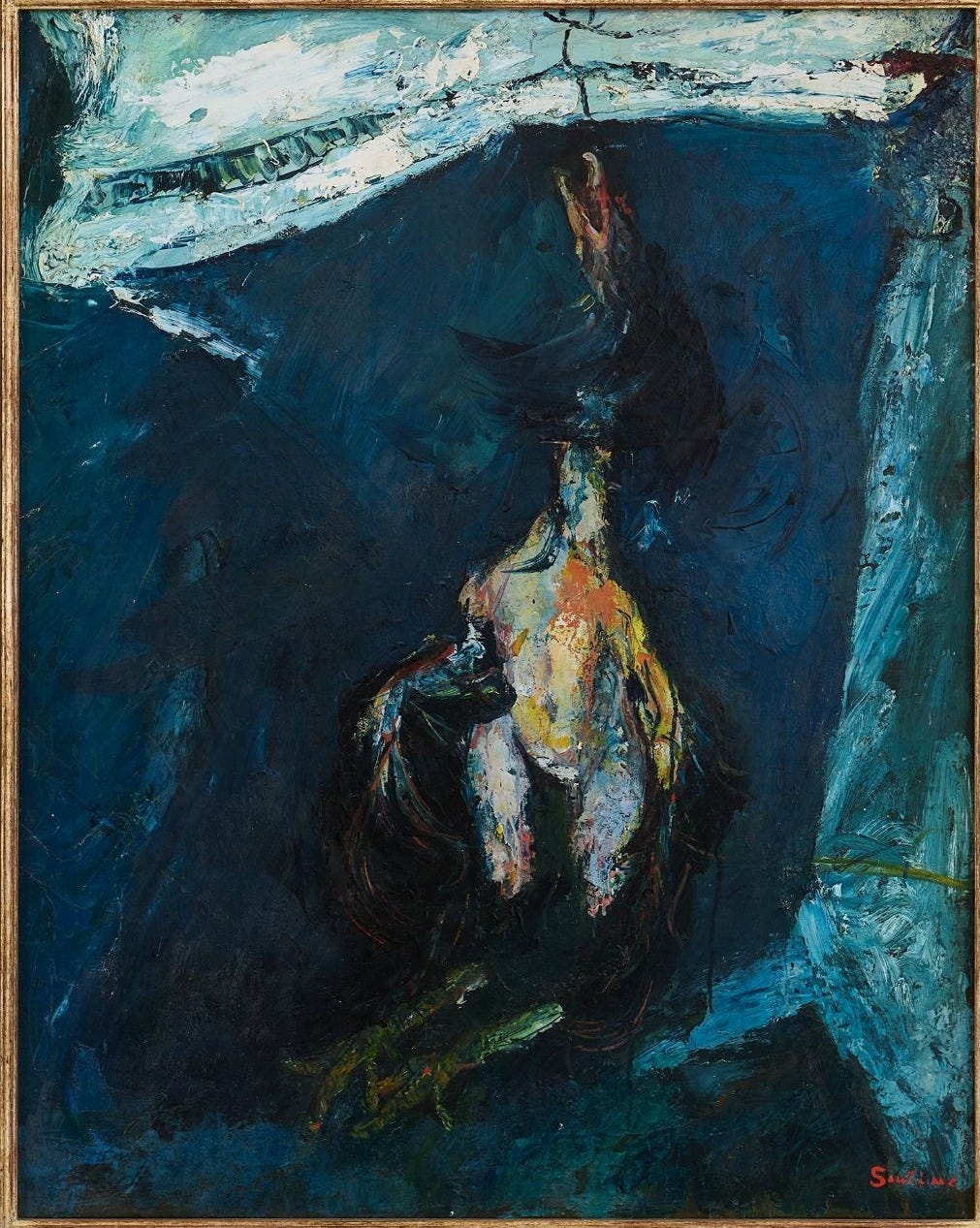
is one of the most arresting paintings I have ever seen. Go visit it while you can. Blink and the show is over!
